Member State Tracking and Jurisdiction Scoping Made Simple
You don't have to determine your EU Pay Transparency Directive (2023/970) obligations on your own. Our platform automatically analyzes your roster data to determine:
Where your organization meets worker count thresholds
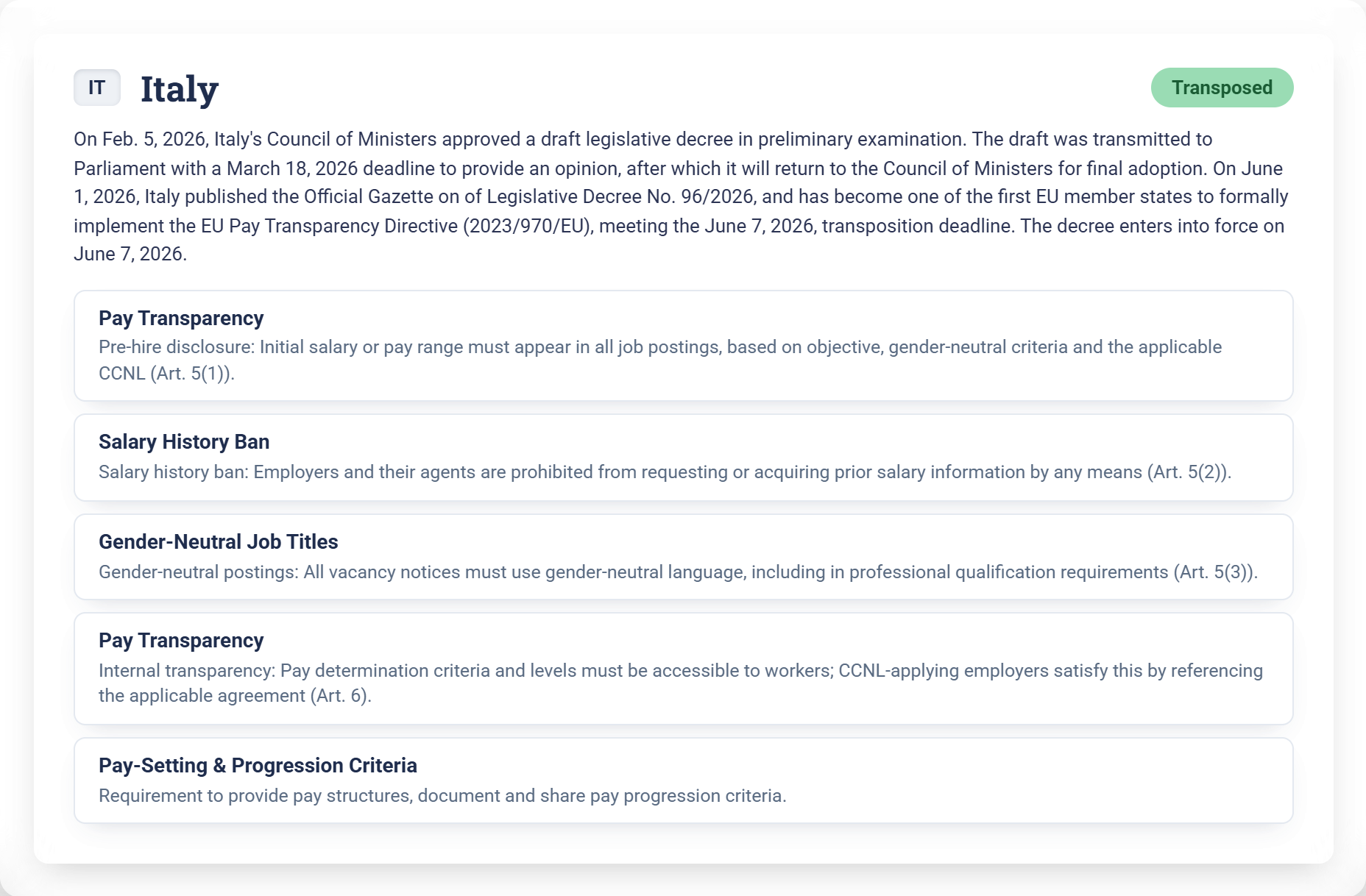
What requirements and prohibitions your organization has in each relevant member state
Pay gap reporting deadlines and cadences your organization has in each relevant member state
Gender Pay Gap Reporting Under Article 9
We've built our platform on 25 years of leadership in pay equity and workforce compliance. You have direct access to the experience and knowledge of our Ph.D.-level industrial/organizational psychologists and labor economists, all at your fingertips. Reporting includes everything required by Article 9(1)(a-g) of the Directive:
Mean and median pay gap analysis of base pay
Mean and median pay gap analysis of complementary or variable pay
Proportion of female and male workers receiving complementary or variable pay
Proportion of female and male workers in each quartile pay band
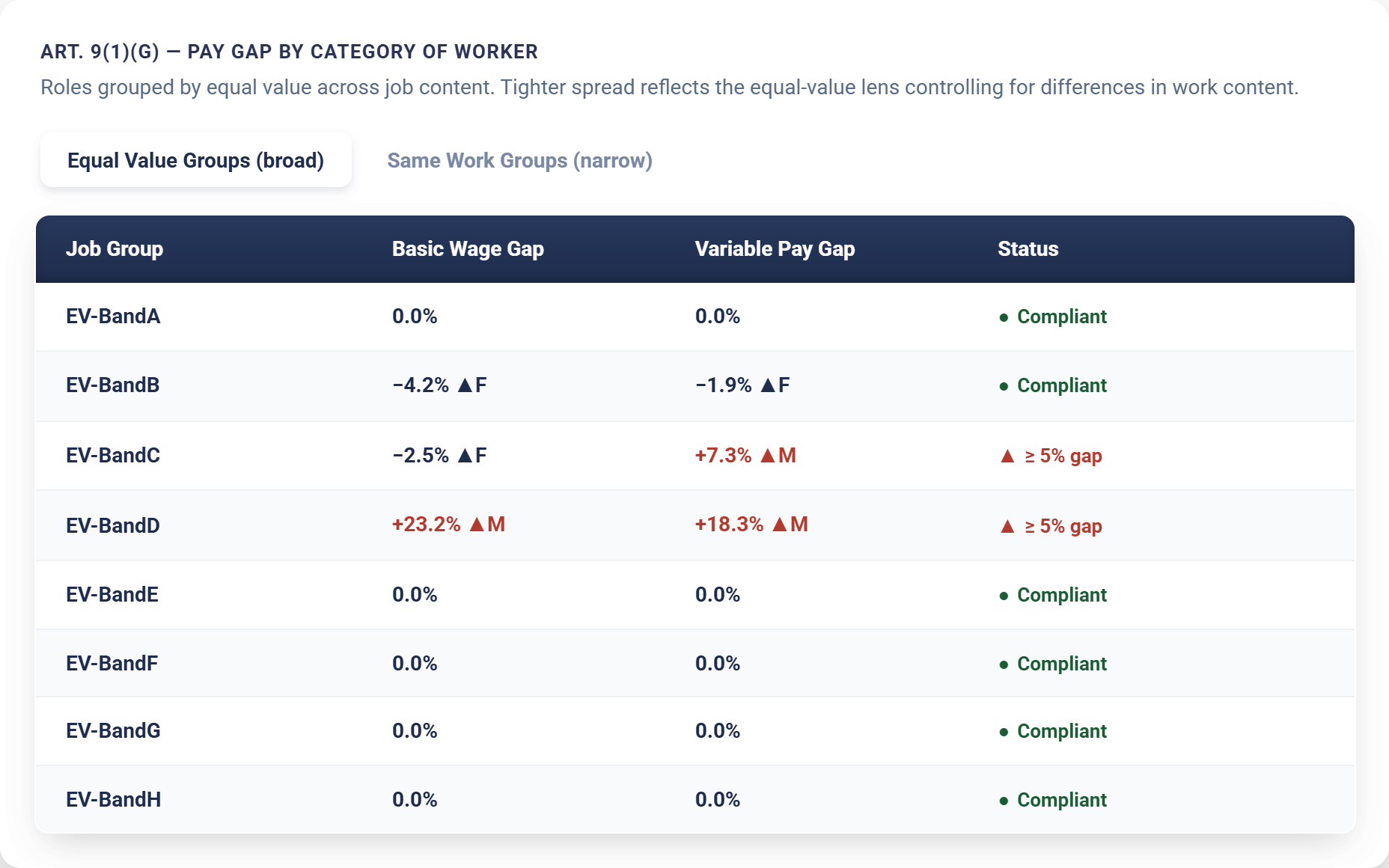
Gender pay gap between employees by categories of workers broken down by base pay and complementary/variable components
Article 7 Right to Information Responses at Scale
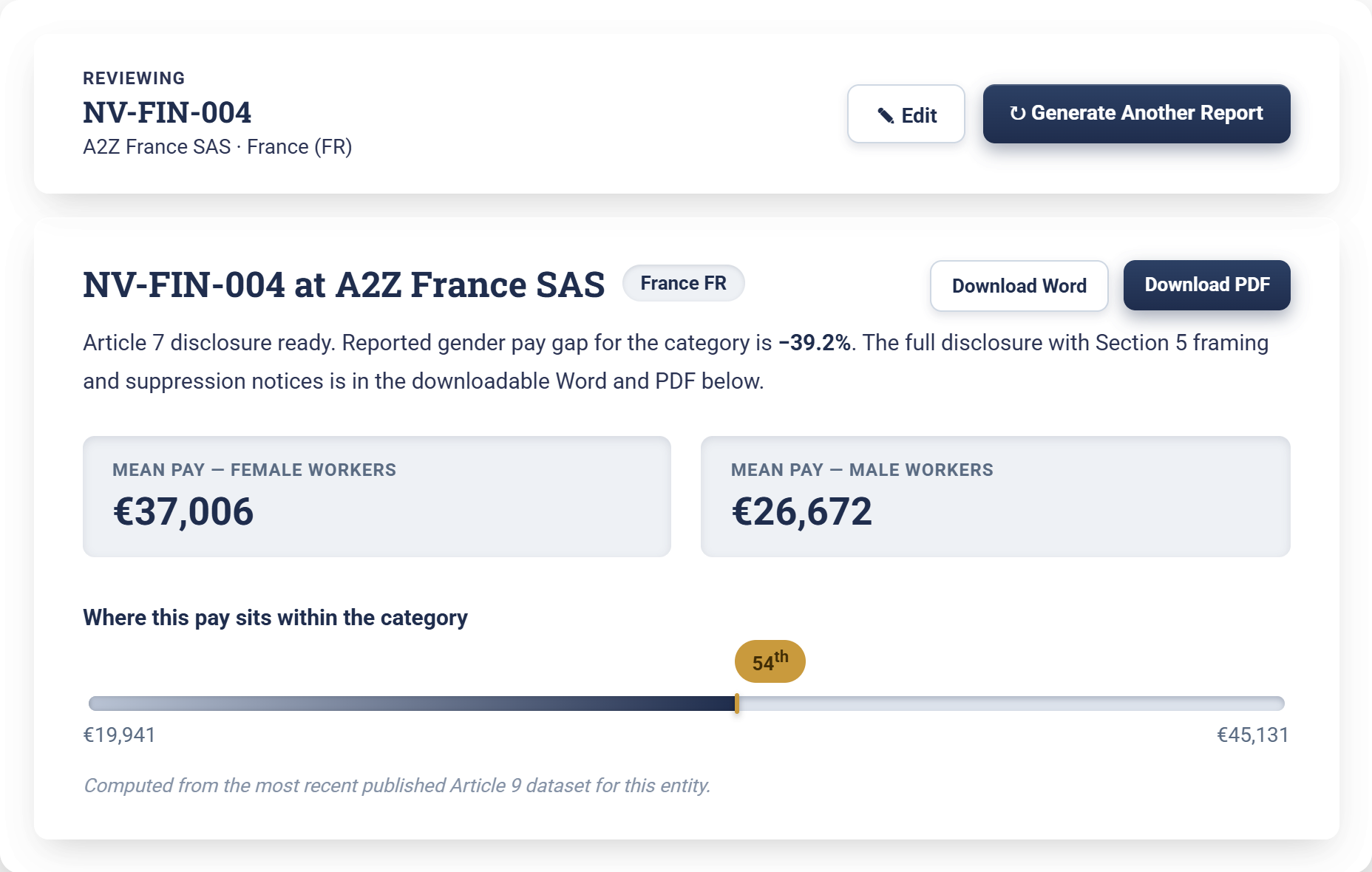
Ensure that your organization is prepared when employees ask about how their salaries compares to others in their worker categories. Our platform has a right to information response generator that allows you to confidently respond to requests individually or in bulk with speed, accuracy, and consistency in compliance with Article 7 of the Directive. Generated responses include:
Explanation of the information included in the response and calculation methodology
Mean pay broken down by sex
Comparison of requestor's pay vs. the mean pay of the workers performing the same work or work of equal value
Automated protection against disclosing pay of identifiable workers
Information about factors not included in the analysis
Job Posting and Pay Transparency Requirements by Member State
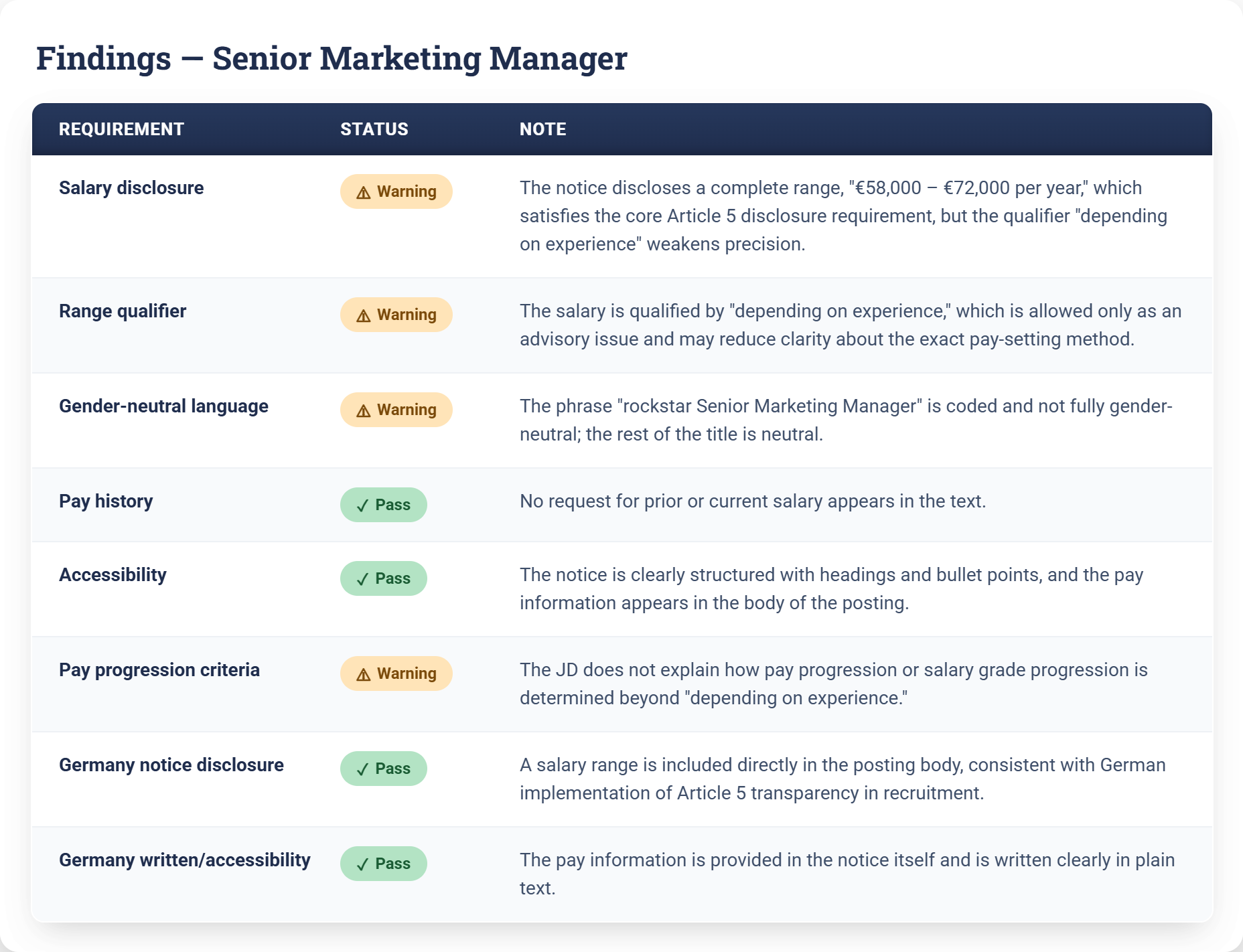
Exact pay transparency requirements differ between member states. Our platform allows you to easily track compliance obligations in relevant jurisdictions and automatically assess job descriptions against country-specific requirements. Automated assessments check for language and items required or prohibited by member states, such as:
Salary disclosure requirements
Gender-neutral language
Salary history requests
Accessibility
Pay progression criteria
Expert Support for Worker Categories, Joint Pay Assessments, and More
DCI's consultants are the foremost experts in pay equity and workforce compliance. In fact, we've built our entire platform on their experience and knowledge. If your organization needs additional support, we can partner with you to ensure comprehensive, end-to-end compliance.
Worker category creation or validation
Strategic employee roster data structuring and preparation
The EU Pay Transparency Directive (Directive (EU) 2023/970) is EU legislation that strengthens equal pay for equal work or work of equal value between women and men. It requires employers to share pay information with job applicants and workers, report gender pay gaps, and correct gaps they cannot justify with objective, gender-neutral criteria. Each member state applies it through its own national law.
Yes. The Directive covers public and private sector employers with workers in EU member states, regardless of where the company is headquartered. A US-based organization must comply with the national law of each member state where it employs workers, and those laws can differ on thresholds, deadlines, and added requirements. DCI’s platform maps those obligations country by country from your roster data.
The Directive entered into force on June 6, 2023, and member states were required to transpose it into national law by June 7, 2026. Employer obligations take effect through each country’s implementing legislation, so timing depends on where your workers are. DCI’s Member State Tracker shows where each country stands.
Employers with 250 or more workers file their first report by June 7, 2027, and every year after that. Employers with 150 to 249 workers also report first by June 7, 2027, then every three years. Employers with 100 to 149 workers report first by June 7, 2031, then every three years. National laws may extend reporting to smaller employers or add requirements, so check each country’s rules.
Applicants have the right to receive the starting pay or pay range for the position, based on objective, gender-neutral criteria. They must receive it early enough to negotiate pay with full information, for example in the job posting or before the interview. Employers may not ask applicants about their pay history, and job postings and job titles must be gender-neutral.
Workers can request, in writing, their individual pay level and the average pay levels, broken down by sex, for workers doing the same work or work of equal value. Employers must respond within two months of the request and must inform all workers each year of this right. Employers also cannot use contract terms to stop workers from disclosing their own pay to enforce equal pay.
Each member state sets its own penalties. They must be effective, proportionate, and dissuasive, may include fines, and must include specific penalties for repeat violations. Workers who experience pay discrimination are entitled to full compensation, including back pay, with no upper limit. Employers that fail to meet the Directive’s transparency obligations also carry the burden of proving that no discrimination occurred.
Transposition status changes frequently. DCI’s EU Pay Transparency Member State Tracker shows the current status in each member state and is updated as countries adopt or amend their laws.
Stay in the know! Subscribe to the monthly EU Pay Transparency Navigator newsletter.